2024 Books

Thursday Murder Club is a series of well-written books by Richard Osman, a British author, producer, and television presenter. We listened to the entire series, though not all, in the first quarter of 2024 and present from left to right in the series order. You cannot trust any of the senior residents living at Coopers Chase Retirement Village, where these four pensioners meet on Thursdays in the Jigsaw Room to investigate unsolved local murders that the local police have let grow cold. Despite the serious nature of the crimes, you will find yourself laughing as Club members find critical clues and make the police look incompetent.

Nathan Hill’s Wellness: A Novel is another NYT Bestseller and NPR Best Book of the Year. It is about a modern couple in urban America who struggle with misunderstanding each other and cannot leave their own dysfunctional childhoods. The husband is also challenged by a MAGA-like father, in his dotage, who has discovered the dark side of internet conspiracies and acts upon them. The wife is involved in the unregulated side of the wellness industry and is financially rewarded, but it eats at her soul. It was an enjoyable read on Audible.

You need to read or listen carefully to the first chapter of James McBride’s well-crafted novel The Heaven & Earth Grocery Store because it becomes essential late in the story. The setting is a grocery store in a black and Jewish neighborhood in Pottstown, Pennsylvania, called Chicken Hill. It is an award-winning, compelling story of community, family, love, and some violence worth reading.

Oath and Honor: A Memoir and a Warning was written by Liz Cheney, a politician I disliked until the Congressional Select Committee investigation of the January 2021 insurrection. I disliked her father even more. I was wrong on both counts. The book and the story are compelling, and I stand in awe of the courage and integrity of Liz Cheney for her commitment to the U.S. Constitution and truth. She reinforces my pride in being a lawyer.

Great Expectations by Charles Dickens finally reached the top of my reading list in 2024. It is a classic, and I’ll not spend much time telling you it should be on your list. This book is not the reason Dickens is one of the great English language authors of novels that have stood the test of time, but it is also a classic Dickens that offers characters you cannot get anywhere else.


Disclosure: We knew the author when she was a child living in Skagit County with her family. Her first book, Maid: Hard Work, Low Pay, and a Mother’s Will to Survive, has been the subject of discussion locally, as anyone who has read it will understand. Her family attended our church in the early 1980s until they moved to Alaska. My wife, Debbie, is identified in the book as the RN who recalled Stephanie and was kind to her at a medical clinic. It was challenging to read her (unsigned hardback) book, knowing the family and not knowing the hardship Stephanie was experiencing in the years she lived in and around Skagit County. I believe her book is highly acclaimed because she conveys raw emotions about a difficult life where no good deed goes unpunished.

Amor Towles has become one of my favorite contemporary authors, so I was delighted when Table for Two was selected for the Skagit Valley Book Club. Towles has assembled a collection of short fiction stories and a novella. Table for Two is fine work but not comparable to A Gentleman in Moscow or Lincoln Highway. That being said, Evelyn Ross, in the novella, is a character not to be forgotten.

News of the World by Paulette Jiles is a book title that has almost no relationship to the theme or plot. That is not true of Chenneville: A Novel of Murder, Loss, and Vengeance by the same author. As you can see from the cover, News of the World was made into a movie because it is a compelling story of hardship, creating character and integrity. Chenneville is about a Union soldier, John Chenneville, coming home to the senseless slaughter of his sister and her family and the struggles he goes through to find their killer. You will find yourself rooting for John to get revenge and justice for his family.

Lessons in Chemistry is more about challenging the status quo than how to combine chemicals safely. This NYT Book of the Year by Bonnie Garmus is about stupid white men trying to control an intelligent woman, Elizabeth Zott, who refuses to accept the 1960s convention. The book was made into an Apple TV+ series I watched before reading. Subsequently, it became a Book Club selection, and I worried that it might not match the quality of the television series. It was worse than I could have imagined.

Men are retarded brutes who live on prejudices and lower base instincts, and women are primarily virtuous and put up with men to save the family. There is the lying bishop at the boy’s home who thinks only of money, the pastor who does not believe in God, the TV station manager who has to be the worst boss ever created in literature and would make Archie Bunker blush, the UCLA dean who raped Elizabeth and got her expelled from school, and her father who is in prison for being an evangelical fraud and murderer and drove his son to suicide. Don’t forget the executive at the lab who is clueless and plagiarizes Elizabeth’s work. The author feeds on stereotypes and prejudice. Still, it was entertaining.

In response to a question about understanding the conflict in Palestine, a friend recommended The Lemon Tree: An Arab, a Jew, and the Heart of the Middle East by Sandy Tolan. Certainly, there are many books on this topic, but Lemon Tree takes a refreshing approach by documenting the histories of two families in Palestine, one Arab and one Jew, centered on a home that belonged to the Arab family before the 1967 Six-Day War. Their story and struggles become a method of understanding the many decades of conflict in Israel. The dialogue between these families brings light to this challenging topic.

This book was written too early. Now that he is in the news more than ever, Walter Isaacson’s Elon Musk should be updated by the author to fully capture the personality of this controversial character. I read the book mainly because of the author’s work in Steve Jobs, another bestselling biography, and I was not disappointed in Musk. I can say I’m disappointed in Mr. Musk (full disclosure: I drive a Tesla) since he purchased Twitter in 2022. Nevertheless, this book deserves your attention if you want to understand Mr. Musk, and there is every reason you should since he refuses to leave the world stage.

I enjoyed and highly recommend James by Percival Everett. Do yourself a favor and get the Audible version, which Dominic Hoffman narrates. James is the Adventures of Huckleberry Finn through the eyes of Jim, the slave who accompanied Huck on his Mississippi River adventure. Audible says: “Brimming with the electrifying humor and lacerating observations that have made Everett a “literary icon” (Oprah Daily), and one of the most decorated writers of our lifetime, James is destined to be a major publishing event and a cornerstone of twenty-first century American literature.” The review is a little over-the-top, but not by much.

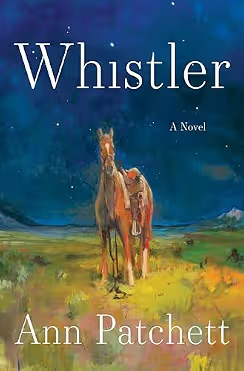
I greatly enjoyed Bel Canto by Ann Patchett, a NYT best-selling book published in 2004. Again, I listened to the Audible version and was delighted with Anna Fields’s narration. I’m not an opera fan, but this book moved me closer to appreciation. Bel Canto means beautiful singing, and you will find beautiful character development in this novel about a botched terrorist kidnapping in an unnamed South American country.

We are fans of John Grisham, and I have read almost everything he has published, including Camino Ghosts. You are in the hands of a master craftsman with this book, which is part of a series about a bookstore on fictional Camino Island. I have more to say about John Grisham’s books here.

Our September Skagit Valley Book Club selection is Peace Like a River by Leif Enger, and it will be interesting to hear the comments from our Club members. This is a decidedly Christian-influenced novel about a midwestern family in the 1960s who experience miracles and heartbreak. The book follows an unpredictable plotline with characters who touch your soul. Our Book Club includes men of faith and men like I was before coming to a saving knowledge of Jesus. The discussion about Peace Like a River should be engaging.

A friend recommended Demon Copperhead by Barbara Kingsolver and said it was over 500 pages (over 21 hours on Audible) and I advised that my book club tries to limit book selections to under 500 pages. Surly, he recognized my comment was more of an excuse than a reason not to read the book. Toward the last chapters, I did not want the book to end. This Pulitzer Prize winner is filled with humor, heartbreak, love and longing, addiction and recovery, structural poverty, and class struggle. There are many characters, and at times, it was hard to keep up, but they are well-rounded and engaging. The plot involves the opioid epidemic in 1990s Appalachia and the destruction that followed as lives were destroyed. It is much more than that and deserves the accolades the book has earned. I knew something about drug addiction from my years as a prosecutor and criminal defense attorney, but the story of Demon Copperhead had much to teach me.

Dancing at the Rascal Fair is the second novel in Ivan Doig’s Montana Trilogy. The first was English Creek, which I read a few years ago and was assigned by my Book Club. The main character in both books is the Two Medicine country in Montana at the turn of the twentieth century, where homesteaders endured harsh conditions that Doig describes in brilliant detail. I was not expecting Dancing to be a romance novel, and I almost abandoned the book at the halfway point. I grew weary of the back-and-forth love life of Angus McCaskill, a young Scottish immigrant to Montana who is better at raising sheep than deciding between two women who come into his life. My persistence was rewarded as Doig painted a picture of struggle, love, family tragedy, and yearning amid the beauty of Big Sky Country in the final and exciting closing chapters. SPOILER ALERT: A boot caught in a stirrup brought an end to life and a new beginning for a long-neglected marriage.

We should start with the rules: You can’t read one without the other, and you must read The Plot first. These two novels by Jean Hanff Korliz are closely related stories about a married couple who are both authors of best-selling novels, with one a plagiarizer and the other a homicidal maniac. Jacob Finch Bonner had an undistinguished writing career followed by spectacular success with a book based on a stolen plot from an author who died before his work was published. The fictional characters in “Crib” are the product of Bonner’s acquired plot, while the real characters in The Plot: A Novel (2021) have different names but similar roles. Bonner marries a woman with a complex background, and everything is going well until things start to unravel. His wife, Anna Williams-Bonner, becomes the grieving widow after Bonner is thought to have committed suicide, and she writes a best-selling novel called “The Afterward” that fictionalizes her husband’s death. Korliz captures that story in The Sequel, published in 2024, which begins where The Plot left off. It turns out that Anna Williams-Bonner specializes in remorseless homicide and cleverly invents rationals for killing parents, a sibling, a daughter, a husband, and strangers when necessary. If that is not enough, she also steals identities. Oh, and the night the lights went out in Georgia is when our protagonist buries her backwoods southern lawyer on top of her daughter’s coffin. You need to both books to learn how that works out.

I feel fortunate that Rocket Men by Robert Kurson was assigned reading by my book club. It is a well-written account of the successful 1968 Apollo 8 NASA mission to orbit the moon, which included the three astronauts returning home during Christmas. As you may read in other sections of the Portfolio, I was in a bunker on the Korean DMZ in the winter of 1968 and knew nothing, or almost nothing, of this historic event taking place around the moon above me. Apollo 8 is on a long list of events I missed in 1968, including the assassinations of MLK, Jr. and RFK, riots at the National Democratic Convention in Chicago, the Summer Olympics in Mexico City, and the release of some excellent (now classic) rock music albums. Rocket Men filled in the gaps for me, not only about the Apollo 8 mission but of many other events in the last half of 1968. The book is also an intimate description of the crew, Frank Borman, Jim Lovell, and Bill Anders, how they grew up, joined the military, became astronauts, their families, their Christian faith, and their sacrifices for the NASA mission. The book ends with four words taken from one of thousands of telegrams sent to the returning astronauts, which read: “THANKS. YOU SAVED 1968.” Reading Rocket Man saved and supplemented my 1968 Army experience, for which I am grateful.

As a practitioner of faith and fly fishing, I found the opening sentence of A River Runs Through It the most compelling. Norman Maclean writes, “In our family, there was no clear line between religion and fly fishing.” The book is more about family and fly fishing than religion. It also becomes clear that rules for life in Montana are like some religious edicts; they remain flexible. Thus, the prohibition on drinking while fly fishing does not include beer drinking. The Scottish Presbyterian Maclean clan tolerates people from other faith traditions but has no respect for bait fishermen and West Coasters. This book is character-driven with enough pathos to make it a compelling read. I enjoyed the many characters, but Old Rawhide has to be the most colorful. The description of Montana geology reminded me of Bretz’s Flood and Maclean’s description of the Megaflood that carved the landscape of Western Montana, Idaho, and Washington. Another successful Skagit Valley Book Club selection.

2025 Books, 2d Half

Several years ago, a new attendee at my church brought to our attention that the chancel platform in the sanctuary was “missing” an American flag. I was not in a leadership position at the time, but I did hear from the man who, on several Sundays, was not shy about sharing his views on the matter. He seemed to believe our church had overlooked a flaw that he was going to remedy. To that end, he donated a flagstand and pole.

When he engaged me on the matter, I suggested that the church is not an American institution and cannot be limited by placing a national flag in the center of worship. The man’s efforts failed, which I believe was a credit to our church. Reading Jesus and John Wayne helps me understand, in retrospect, what the flag-obsessed man was trying to achieve and what drove his passion to reform our church. He was introducing an early version of Christian Nationalism to an otherwise healthy church. It was a hard book to read and even angered me at times. It explains in historic detail how white American evangelism has failed and fractured our country. If just the mention of those terms in the last sentence bothers you, read the book!

The dual nature of the protagonist Harry Haller, as half human and half wolf, is that of an unhappy man who struggles against the meaninglessness of bourgeois German society after World War I. Death is a repeated theme, mostly centering on suicide and murder. The wolf is an image of hedonism and primal instincts. Steppenwolf exists in a world he cannot understand, causing despair and depression. He sees relief in death, but lacks courage.

The book dissolves into magical realism as Haller experiences surreal visions of various German artists, composers, and intellectuals while he goes about the business of assassination and murder. The author, Hermann Hess, believed the book offered a message of transcendence and healing. That message was lost on me amid depictions of lust, casual drug use, and self-indulgence.

The historical fiction story of Nancy Wake, a World War 2 spy for the British, by Ariel Lawhon. Wake started as a journalist with the Hearst newspapers in Paris, married a Frenchman before the war, then escaped after the Nazi’s invaded France. She parachuted back into France as a British SOE operative, code name Helene, but the Gestapo called her The White Mouse, and the Allies heavily decorated her after the war for her extraordinary service.

This captivating and important story is carefully crafted by the author, who uses both first-person and third-person narratives in alternating chapters. The character development is very well done, although the gay Hungarian radio operator who insisted on calling Nancy “ducky” became a distraction. Some characters are beyond contemptible and mostly get what they deserve, except Henri Fiocca’s father, who is despicable and remains unpunished.


A favorite nephew gave me this audiobook as a birthday present, and I feel blessed. BBC Radio released this Dorothy Sayers collection of plays based on the Gospel accounts of the life of Jesus Christ in contemporary language. The plays begin at the Nativity and continue through the Resurrection of Christ, accompanied by musical scores. It was a new way to experience the greatest story ever told, which never gets old.


The list of bad actors on Wall Street that caused the 2008 market crash and then made a profit are identified in The Big Short by Michael Lewis. The tragedy is how few went to jail. The book is a testament to financial reform at a time when nobody is demanding reform. Lewis uses characters to explain obscure terms, such as Credit Default Swaps and Subprime mortgage bonds, which were festering in the market while rating companies gave triple-A ratings to mortgage bonds and other instruments that were headed for financial failure. As an investor myself, it is hard to understand how otherwise intelligent people were so blind to what they were doing.

I wish I could say that Ken Follett does not disappoint with Circle of Days, but it simply is not his best work. Follett is one of my favorite authors, and I am glad to have read Circle, but it does not compare with many of his great novels. When I finished the book, I had to ask whether this is about an ancient culture that created Stonehenge or a clever comment on the nature of humans and our modern world.

The delightful part of the book was Follett’s explanation of how and why Stonehenge was created on the “Great Plain” by a primitive culture of farmers, herdsmen, flint miners, wood dwellers, and priestesses, who cooperated to make something bigger than themselves after years of drought and intertribal warfare.

Sources of the River is about David Thompson (1770-1857), a Canadian explorer, surveyor, fur trader, and cartographer, who mapped the Columbia River and most of the northwest territory. He mapped 1.5 million square miles of wilderness, yet he died in Montreal in near obscurity and poverty. A hundred years later, Canada issued a postage stamp in his honor. The book by Jack Nisbet was a worthy book club selection.


DISCLOSURE: Amy Muia is a friend, and likely makes it impossible to provide a completely objective review of A Desert Between Two Seas. The fact that it is the winner of the Flannery O’Connor Award for Short Fiction speaks for itself. Desert is not a travelogue about Baja California, Mexico. Yet the harsh 19th-century setting mirrors the desert in the hearts of the two main characters, who are surrounded by ruined Catholic missions that brought little light to an exploited native people. The book is identified as “a novel in stories” because each chapter is a story unto itself, but Amy managed to link the stories together like pearls on a necklace.

Amy is a fluent Spanish speaker and conducted extensive research. She spent time riding mules in the dust of Baja, collecting stories and absorbing the details of how a forbidding landscape shaped the lives of people in the desert. The book is an excellent read about fascinating and tragic characters who search for a better future in a land that clings to the past.

Robert Langdon, Dante Alighieri, Botticelli, Florence, Venice, secret codes, murder, Italian police, and a young blond doctor, all within 72 hours! If you like fast-moving thrillers, this book may be for you. There is a pattern to Dan Brown’s books, but this one throws us a curve, more than once, which kept it interesting. I started to grow weary as the last 50 pages (2 hours of listening) seemed somewhat unnecessary.

Also Coming Soon . . .

Fredrik Backman

A native of Sweden, Fredrik Backman’s work, published in 25 languages, has made him a #1 NYT best-selling author. You don’t need to be an ice hockey fan to enjoy his writing, but it might help. I’ve read three of his books, and they are all set in Sweden, but again, you don’t need to know very much about Sweden to enjoy his work. I find the development of characters to be the most powerful aspect of Backman’s writing.

Every chapter is named “A Man Called Ove,” followed by a descriptive phrase, yet I believe the entire work is about misdirection. The best thing you can say about Ove is that he is a curmudgeon with a long list of dislikes about his life and the world where he lives. The book is about the women in Ove’s world who guide and encourage this disagreeable “bitter neighbor from hell.” Backman has created a heartwarming story about remarkable women who learn how to deal with an angry old man. In every chapter, we are misdirected into thinking we are reading a story about Ove, who has learned not to trust people in white shirts.

Some lines in the book are so profound or memorable that I wrote them down while listening to the book on Audible. Here are some examples: “He looked at the cat with an expression reserved for cats carrying Jehovah’s Witnesses Bibles in their paws.” I can’t get that mental image out of my mind. How about this: “He said to her, ‘I just wanted to know what it felt like to be somebody you looked at.'” This last one gives me chills: “One man who cannot forget the past stares at the other who cannot remember the past.”

The Beartown Trilogy: Beartown, a book club selection, and Us Against You is the second in the series. I have yet to read the 3rd book. The setting is Beartown, a fictional hockey empire that lives to defeat a rival community in both hockey and life.

Frank Herbert

Frank Herbert (1920 – 1986), a Tacoma native, sold more science fiction books than any author in history. I became a fan after reading Dune while a college student. I don’t recall how many of his books I have read, but the list includes Dune Messiah, Children of Dune, God Emperor of Dune, and The White Plague. All the books, except the latter, are in paperback, leading me to the point of this story. The student newspaper article below explains why Herbert was on the CWU campus at my invitation. At the time, he lived in the Puget Sound area and drove to Ellensburg with his wife. Before his presentation, I had a few minutes to talk with Mr. Herbert at the student union building, and I asked if he would autograph my copy of Dune. He was sitting across a desk from me, and I noticed he glanced at his wife when I handed him my ($1.25) paperback copy. He graciously signed the book. It was not until years later that I realized how short-signed I was in asking an author of his statue to sign a paperback and why he glanced at his wife. I think he understood why a college student could not afford hardback books for recreational reading.

2025 Books, First Half

Frank Herbert has sold more science fiction books than any author in history. The White Plague is not his best-selling work, but it is an interesting read because it is about something hard to imagine when it was published in 1984: a worldwide pandemic starting in Ireland. If you have never read Herbert, start with Dune, an epic work of science fiction. I became a fan when I was a student at CWU, where I met the author and had him sign my copy of Dune. The story of meeting Frank Herbert is a bit embarrassing, and you can read it here.

The Beartown Trilogy by Fredrik Backman: Beartown was a book club selection, and Us Against You is the second in the series. I have yet to read the 3rd book, The Winners. Backman also wrote A Man Called Ove, which I reviewed here.

Captain James Cook was given special immunity by the United States during the Revolutionary War but not by modern critics who are eager to point out his transgressions. The Wide Wide Sea by Hampton Sides is a fascinating and insightful account of Cook’s 3rd and final voyage of exploration to find the fabled Northwest Passage. A secondary purpose was to return Omai, a French Polynesian man, to his homeland. HMS Resolution and HMS Discovery sailed from England in July 1776, just months after the Declaration of Independence. Cook knew little about the American Revolution, but the Colonies realized he was on a voyage of discovery, so he was given immunity.

The author was aware of controversies surrounding the “Doctrine of Discovery,” which promoted and justified European exploration in the name of God and Country for many centuries. Sides carefully points out that James Cook was not a conqueror, privateer, or pirate but a British Royal Navy Officer who was an expert navigator and cartographer with a preternatural ability to find dry land. Cook was also aware that what he “found” by exploration had already been discovered by the local natives. He often ascribed native language names on his charts to areas in the many locations his ships traveled. Cook was mindful of the “eternal and everlasting curse” of VD that his crew brought to innocent women and did what he could to stop the scourge. Ultimately, Cook concluded that a usable Northwest Passage between the Pacific and Atlantic did not exist. The Wide Wide Sea is a great read.

The “Neapolitan Novels,” written in Italian by a pseudonymous author who grew up in Naples, said that once books are written, they do not need authors. Read more here about these books.

The Demon of Unrest is the story of events leading up to the Civil War, including Abraham Lincoln’s election. Erik Larson compares pre-civil war South Carolina (SC) to Miss Havisham in Great Expectations, as she retired from the world, stopped her clocks, and wore her wedding dress forever. It was a state filled with pretentious, self-aggrandizing slavers fed lies by local media about Northerners, the free states, and Lincoln’s campaign. Southerners saw themselves as morally superior and more masculine than the Yankees. As SC seceded from the Union, the Illinois lawyer demonstrated restraint and wisdom as he tried to hold the Union together until the moment SC fired the first shots at Fort Sumter.

In this time (2025) of unrest, our nation’s leaders are turning against allies and neighbors who have been at peace with us for generations. My friends who support this turn-around say that we should not care what other countries think about America, and the suggestion that such opinions matter is evidence of disloyalty. Larson finds an outside voice that should have been listened to by both sides of the conflict, British Journalist William Howard Russell, who lived in America in the 1860s and was reporting for The Times in London. His wise observations about America during the build-up to our Civil War add substance and insight to Larson’s work.

40: A Collection of Modern-Day Parables by John Cleveland is a book that should be read slowly. I read one or two parables and would then think about the message for the remainder of the day. Jesus taught in parables for a number of reasons (Matthew 13:10-14), including the fact that stories stay with us for generations, i.e., The Good Samaritan or The Prodigal Son. We have the advantage of over 2000 years of study, analysis, scholarship, and preaching to consider the parables taught by Jesus. Some of Cleveland’s parables deserve more thought and reflection, while others are straightforward. By the time I reached number 40, I did not want the book to end. The last parable may have been his best.

Greer Hendricks’s The Sublet: A Short Story, an Amazon Original by this bestselling author, is available on Kindle and Audible. In this engaging, plot-driven story, a ghostwriter sublets a Manhattan apartment from the aspiring author, and her life is never the same. It is a fun read and could have been a full-length thriller. But as a short story, it was a nice change of pace.

Precipice: A Novel by Robert Harris is a historical fiction novel set in 1914, as WWI was about to change the world. The central characters are Herbert H. Asquith and Venetia Stanley, two British aristocratic figures involved in an affair that could have been ignored had Prime Minister Asquith not been in the habit of littering the English countryside with classified and top-secret telegrams and dispatches. The documents end up in Scotland Yard, where we meet a young police officer who has to track down the security leak in the British government.

The Husbands by Holly Gramazio is best read in small doses without expectation of substance or flavor. I found it tedious and pointless. There is no character development in the endless parade of husbands (speed dating comes to mind) that descend from the protagonist’s attic. The “wife” becomes a Black Widow after having sex with some of the husbands and swapping them for another. One star!

Silas Marner: The Weaver of Raveloe by George Eliot is a revered classic and delightful read. It is a tale of poetic justice, decades in the making. Silas suffers a double loss. The truth hidden is still the truth, though known only to the victim, the villain, and God. The author (Mary Ann Evans) has a gift for creating a story and gives her reader insight and involvement in the characters’ lives. Try this wonderful sentence: “A dull mind, once arriving at an inference that flatters the desire, is rarely able to retain the impression that the notion from which the inference started was purely problematic.”  A great read by a great writer. There is “gold” in those pages.

Mad Honey is a love story, a courtroom drama, and beekeeping instructions. The hero is a criminal defense lawyer surprised mid-trial with evidence from a pathologist that upends the defense strategy.  The underlying moral of the novel is that bad fathers produce dysfunctional children. I had much to learn about the lives of queen bees, drones, and transgender people. I highly recommend the Audible version.

Twist is about the perils of fixing undersea fiber-optic cables off the coast of Africa. Colum McCann suggests that the cables are the new colonialism, and writes sparingly about the process of finding the breaks in the depths of the ocean and making repairs. He leads us on a moderately interesting journey about the head engineer who controls the ship of repairmen and how his life is broken, much like the cables.

Frieda McFadden has written a series of books for Amazon in the Kindle format called the “Alibis Collection.” Death Row is a psychological thriller, a genre that is not usually part of my reading pattern. I would consider it a page-turner except for the fact that I read it on my iPad. The book was a free offer from Amazon, is only 72 pages long, and is an excellent introduction to a talented author. McFadden, a physician, has written several best-selling books and received numerous awards. I look forward to reading more of her work.

In The Road to Wisdom, Francis S. Collins offers a compelling explanation of how faith and science are combined in the pursuit of wisdom. The base of that road is truth, and the source of truth is found in Jesus. Collins graduated from Yale with a PhD in physical chemistry, then changed fields and went to the UNC School of Medicine and became a medical doctor.

Collins was the director of the National Institutes of Health under three presidents: Obama, Trump, and Biden. He was also the director of the National Center for Human Genome Research and oversaw the Human Genome Project, about which he said, “It is humbling for me, and awe-inspiring to realize that we have caught the first glimpse of our own instruction book, previously known only to God.” Now that he has mapped the human genome, Collins is mapping the divide between people in our contemporary political and cultural climate, and offering wise solutions. The book is a must-read.

Russell Moore, the author of Losing Our Religion, was a solid conservative Southern Baptist preacher and theologian; yet his story is defined by his criticism of Donald Trump. Moore is most recently on staff at a nondenominational church in Nashville and Editor in Chief for Christianity Today. Moore argues that American evangelical Christianity has lost it way and church congregations are torn apart by Donald Trump.

Moore sees evangelicals walking away from evangelical churches not because they do not believe what the church teaches, but because they believe the church itself does not believe what it is teaching. Thus, Christianity has declined into political tribalism and culture warfare. He is particularly critical of Christian Nationalism, saying that it is to Christianity what the Nation of Islam is to the Muslim faith. He says evangelicals have to turn away from tribalism and embrace truth and that truth is Jesus Christ. That is why the book is An Alter Call for Evangelical America.

Slaughterhouse Five, published in 1969, was hailed as a great anti-war, nonlinear science fiction novel about the bombing of Dresden, Germany, during WWII. It put Kurt Vonnegut and Dresden on the map. I wasn’t ready to read it in 1969, perhaps because it was still unclear in my mind about my convictions concerning Vietnam and the anti-war efforts on campus. My focus was on recovering from my own Army experiences and my return to YVC. Reading the book over 55 years later, I can see why it was celebrated; however, I was not thrilled by Vonnegut’s writing style or Bill Pilgrim’s time travel to the fictional planet of Tralfamadore.

Stephen King

Stephen King is a prolific and talented author of over 65 novels. He is known as the “King of Horror,” a genre that is not my favorite. However, I do admire King’s writing skills, humor, and his politics. My first reading of King was The Dark Tower: The Gunslinger, which was enough for many years. When I got my first Kindle in 2009 from Amazon, I downloaded Ur, a King novella that was only available in digital format, which I enjoyed. More recently, I read Billy Summers and Fairy Tale, both of which were engaging. I also read On Writing, in which King tells us about what is involved in being a best-selling author. King also wrote under a pseudonym, Richard Bachman, for several years, announcing in 1985 that Kachman’s death was from “cancer of the pseudonym.”

Short Stories

I began writing short stories during the COVID-19 pandemic, starting in 2020. It was a time of lockdown; the courthouses were closed, I couldn’t meet with clients in person, and litigation became almost impossible. My practice seemed to be centered on Zoom video conferences. I decided to become a part-time lawyer. Essentially, the pandemic was my pathway to eventual retirement. Writing short stories became my creative outlet.

Most of these stories were written in response to contests issued by Reedsy.com, a publishing company with an online platform connecting authors with publishing professionals to create books. It also offers writing tools and educational courses for writers. Self-publishing is a component of Reedsy’s services to writers. They sponsor a weekly contest for short-story writers and select a winner after all entries are evaluated by their editors. The rules are that the story must be written within one week, no longer than 3000 words, and follow a prompt selected from a list of five offered that week. The prompts and the contest rules may explain why some of my stories are on rather strange topics. I hope you find some of the stories enjoyable.

The stories are copyrighted © 2024 Tom Moser. All rights reserved.

Written in response to: Write about a character who wakes up in someone else’s clothes — or utterly weird apparel they don’t recognize as their own.

Written in response to: Write a story that includes someone (or something) saying, ‘No, don’t!’

Written in response to: Write a story that begins with an apology. NOTE: Reedsy added this warning to my story, “Content warning: Themes or references to discrimination and race.

Written in response to: Write a story featuring an animal who subverts expectations (like a snuggly tiger, or something more magical, like a literal fish out of water).

Written in response to: One day, the sun rose in the west and set in the east.

Written in response to: Before bed, you put your clock ahead one hour for daylight saving time. When you wake up, you realize you’ve gone forward a lot more than one hour.

Written in response to: Write a story about someone who receives an unexpected phone call.

Written in response to: You go for a walk in fresh snow. Suddenly, you realize you’re not leaving any footprints.

Written in response to: Write about someone who works an average job — but incorporate elements of magic into it.

Written in response to: Write about a character who goes by many different names throughout their life.

Written in response to: Write a short story about a jury of people tasked with making a decision. (It doesn’t necessarily need to be a court jury.)

An Abandoned Harley in Reno

The Boxer

A Christmas Carol Miscast

Earth 3.0

Snow Along The DMZ

The Veil Woven By Mercy

Even The Dead Have Assignments

The Retraining of Sadie

Jurors Do The Math

Pat Conroy

Reading a Donald Patrick Conroy novel is like watching an artist turn paint into forms and colors that grab your imagination. The first Conroy book I read, Lords of Discipline, drew me into the author’s world of military family life, violence, denial, discipline, loyalty, and sports. Conroy was the abused son of a U.S. Marine Corps fighter pilot who called himself The Great Santini, which became the title of his son’s 1976 novel. It also became a movie, as did many of Conroy’s novels. Conroy is recognized as a leading figure of late-20th Centry Southern literature. His writing caused family and other people to avoid and even sever ties with him, but Conroy persisted in speaking the truth on difficult topics such as military hazing, racism, and his own childhood pain. In an NYT interview, Conroy said, “The reason I write is to explain my life to myself . . . I’ve discovered that when I do, I’m explaining other people’s lives to them.”

Lords of Discipline By Pat Conroy
The Great Santini By Pat Conroy
The Prince of Tides By Pat Conroy
Beach Music By Pat Conroy
South of Broad By Pat Conroy
The Water Is Wide By Pat Conroy

The books shown above are only a sample of my reading of Pat Conroy. Other titles include My Losing Season and The Death of Santini.

I often read one of Conroy’s novels, cringing at one moment and then chuckling at the next paragraph. He wrote to express himself and make sense of his life. An example of his bitter-sweet writing is this compound sentence: “I never had anyone’s approval, so I’ve learned to live without it.”

John Grisham

For many years, I avoided John Grisham and his fellow writers of legal thrillers. The same was true about TV episodes based on courtroom scenes and legal dramas. As a practicing trial lawyer who handles both criminal and civil litigation, I did not see or appreciate the reality of my life compared to the entertainment in books, TV, or movies. At some point, I read about John Grisham’s real life as a practicing lawyer before and during his early writing career, so I gave The Testament (published in 1999) a chance, followed by The Pelican Brief (published in 1992). My misgivings about legal novels dissolve as I read the story of a soon-to-be deceased wealthy man with a broken relationship with his missionary daughter and the lawyer tasked with finding the woman on the mission field in Brazil. I have read almost every novel he has written, including the Theodore Boone legal thriller series written for young readers. Grisham has written a series of books based on other characters who are lawyers, including Jake Brigance and Mitch McDeere. His latest series is about Camino Island, and the lead character is a bookstore owner in Santa Rosa on the fictional Florida island of Camino, not to be confused with Camano Island in Washington State. Grisham’s descriptions of courtroom procedures, rules of evidence, legal strategies, and client behavior are much like my courtroom experiences.

A Few Novels By John Grisham

Ken Follett

This author deserves a special place on any book list with a series. Kenneth Martin Follett is one of my favorite novelists, starting with Eye of the Needle, a spy thriller written in 1978 and made into a movie of the same name. After publishing many thrillers and historical novels, he created at least two series: Century Trilogy (2010 to 2014) and the five-book series Kingsbridge (1989 to 2023). The British author has sold more than 160 million copies of his works. The first character you meet in the Kingsbridge series is Tom Builder, a 12th-century Master Stonemason with a brilliant mind for his craft and is commissioned to build a cathedral in a small English village called Kingsbridge. You meet his family, the nobility that oppresses Tom and his family, and the church clerics as they struggle to survive in a feudal system of injustice, disease, and death. Those characters and their children continue in the book series for several centuries.

Kingsbridge series:

Century Trilogy:

Version 1.0.0