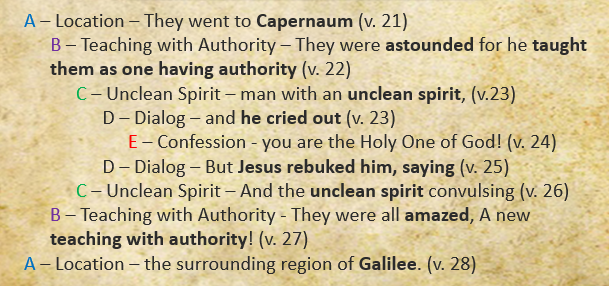
Mark 1:21-28 Chiasmus
The best-known chiasmus, which many people still recall, was delivered by President John F. Kennedy, who stated, “Ask not what your country can do for you; ask what you can do for your country.” That compound sentence is called an ABC chiasmus. Other forms of chiasmus are longer and more complex. We often see that the point and focus of a complex chiasmus are revealed in the center. For example, see Mark 1:21-28, where the central idea is that Jesus is the Holy One of God. Later in that chapter, Jesus heals a leper, which is also a chiasmus.
A simpler chiasmus in Mark 2:27 is here.
In Mark 4, the parable of the Sower is here.
In Mark 6, the story about the beheading of John the Baptist is here.
Mere Christianity by C.S. Lewis came into my reading life with an impact that many other readers have experienced. That was followed by The Screwtape Letters, a satirical novel depicting the dialogue between demons in hell plotting against the forces of heaven. One of many points in these books is the concept that we are on a spiritual battlefield where we are not the warriors; we are the prize. I’m sure the idea can be stated more clearly by theologians, but Mere Christianity and The Screwtape Letters are not written for them. There is no Switzerland where one may stay neutral in this world of conflict. The Bible tells us we have an enemy who is willing for us to live with a delusion of neutrality. Satan is not about worship, just control. He does not need our respect or love. God, on the other hand, does want our love. Satan’s goal is to keep us away from Jesus, who God sent as a ransom for many. Satan does not care if we believe in him or even whether we believe he exists. Satan couldn’t care less that we are religious, just that we do not become followers of the Lord Jesus Christ.
I was at the point where I realized that not making a decision was working for the enemy camp, a place I did not seek or want. The path to escape is not hard to find but requires a step of faith. By this time, I had completed reading the first three New Testament gospels and was just starting the Book of John. The evidence pointed to Jesus as the Messiah sent by God for the work of salvation. Chapter 6 of John describes a time when disciples were leaving Jesus because he was teaching that he was the bread of life, having come down from heaven, which gives eternal life when eaten. In response to this message, people who had been following him walked away. Jesus turns to the twelve and asks if they also want to leave him. At this, Peter answers in verse 68, “Lord, to whom shall we go? You have the words of eternal life. We have come to believe and to know that you are the Holy One of God.” There it was. Where was I to go? Peter was right; nobody talks with authority like Jesus. In all of my studies, only Jesus offers life and salvation from God.
In February 1984, while jogging, I decided to make Jesus the Lord of my life and accept the gift of salvation through faith in him. I was free of the fear of death, free to enjoy salvation and live a life focused on what God wants me to do while I still live. The challenges and disappointments in my life did not go away. The difference was that now I had God helping me walk the lighted path out of the darkness. That is the point: I was in spiritual darkness until I asked Jesus Christ to become the Lord of my life and lead me into the light of his truth.
Thank you for reading, and I hope something in this narrative is helpful or inspirational for you.
My growing confidence in the Bible allowed me to focus on the New Testament, setting aside what I now saw as inferior books and unpromising religious traditions. I started reading books about the Bible and the Christian faith, still unwilling to make a commitment to a decision about faith in Jesus Christ. A book that caught my attention was Evidence That Demands a Verdict by Josh McDowell, first published in 1979 and revised over the years. For a trial lawyer who deals with evidence every day, the title alone was compelling for two reasons. Facts are stubborn things, and so is evidence of those facts. And facts require a decision. I was challenged on both scores. I was comfortable not making a decision about the person of Jesus Christ, about who he claimed to be, and the evidence of miracles he performed. Someone suggested to me that a decision not to decide is a decision. There it was, right in my face, the obvious position I was in, thinking that I did not have to make a decision. Telling myself I did not have to reach a verdict based on evidence. Another barrier was being challenged.
I needed someone to talk to who could answer questions and not criticize my indecision about Jesus Christ. Remembering his earlier offer, I told Dennis Swanson I had changed my mind about a Bible study. Dennis worked for the State Parks Department, had some flexibility in his schedule, and was willing to adjust to accommodate my overly demanding schedule (another point of pride). We started a weekly meeting at my office in the courthouse annex at 4 PM, just before closing time. Dennis did not look or act like a terrorist, but among the courthouse staff, there was a chill in the air as he walked through the building to my back corner office. All eyes were on the affable man carrying his well-worn Bible with bookmarker ribbons hanging out of the ends as he walked to the boss’s office.
Dennis started our study with a workbook-style series of publications from The Navigators designed for Bible 101 adult students. The focus was on the New Testament and the person of Jesus Christ. I asked questions, discussed the Bible text, and explored the deeper meaning of the life of Jesus Christ. If Dennis did not know the answer to my questions, he promised to return the following week with answers. No matter how difficult the questions or how much doubt my questions exposed, Dennis was never offended or put on defense.
Click here for more of the story.
I mentioned earlier that I had begun reading the Bible to fill the gaps in my knowledge of biblical stories and characters. Reading the Bible was not enough for me; I felt I had to open myself to comparative religions. The thought was that religion is a philosophy in a world filled with differing views on life, cultures, and the afterlife. I reasoned it was not up to me to say that one religious view was superior to another. In all my pride, I wanted to be open to other traditions. It seemed to me a search for truth had to be expansive and robust. I would still read the Bible, but I supplemented the reading list with other books and essays to compare religious views.
I placed a high value on the social principle of inclusion so that I could not be accused of bias or prejudice. I read the Koran (English version), the Book of Mormon, Pearls of Great Price, and several books and essays about what was then called New Age religions and the Hindu faith. At that time, I had three friends in Skagit County who became deeply involved in the Erhard Seminars Training (EST) program. One of those friends went so far as to fire an employee who refused EST training because, as a Christian, she correctly understood that EST was a New Age religion. What I heard from my friends about EST made no sense to me, so I kept reading.
I continued daily reading of the Bible, and the other materials mentioned above. My goal was to find truth among competing religions and philosophies through study. I felt no pressure, being content with learning and attending a church where our family felt comfortable.
Slowly, it became clear to me that the Bible was not just the first among equals regarding sacred text. It had no peers, and there was no other text on the same level as the Bible. Another barrier to faith was being challenged. This time it was the concept that I could do it my way, that I could create my own map to truth about God, salvation, the afterlife, while trusting myself as the designer. As a wise person once said, if you don’t know where you are going, any map will do. The Bible teaches that God is the designer and the ultimate author behind the Bible. He is the creator, and we are his creation. I had to accept that the path was already designed. So, what was that path?
I completed the Old Testament and started reading the New Testament. By this time, my earlier questions about the names of Bible characters had been answered. I also realized from listening to sermons and attending adult Sunday School that the New Testament was about Jesus and others who lived during his time on earth. In his sermons and during my information discussions, Pastor Nelson encouraged me to read and study the Bible. There was an emphasis on study.
As I started the Book of Matthew, other books about the New Testament came to my attention. My reading was exclusively about Christian history, various denominations, and Christian worship traditions.
One Sunday at church, Dennis Swanson approached me and asked if I was interested in doing a Bible study with him. I politely rejected his offer. This was a self-study mission, I told myself. I didn’t need any help. Dennis accepted the rejection gracefully and said to let him know if I changed my mind.
Click here for more of the story.
When I heard Bethany Covenant Church, the first thing that came to mind was a legal contract, a covenant between people, not a church. I told Debbie about my visit from the Catholic /Baptist evangelists, and we decided to put Bethany on our short list of churches to visit. This meant another visit to a new nursery or Sunday School for our daughter.
In those days, Bethany was located in a residential neighborhood in a modest building with a small parsonage next door and a parking lot on the other side. As we approached the building, we asked somebody if the church had a nursery and were directed to an exterior door. By this time, our daughter anticipated what was happening and was once again clinging to my leg. We opened the nursery door and were greeted by an elderly woman across the room. She saw our daughter, smiled, got down on her knees, and opened her arms. We watched in shock as our daughter let go of my leg and ran to this stranger, who quickly hugged her and welcomed her to the church. Debbie and I were almost alarmed at how quickly our child left the family’s protection to run into the arms of someone she did not know. After a moment of hesitation, we closed the door and headed for the church sanctuary.
Our intention at these church visits was to be as invisible as possible, keeping personal contacts to a minimum. We were there to “take notes,” so to speak, and evaluate what the church had to offer. We were immediately impressed by the young pastor, Dwight Nelson, whose delivery was appealing. After the service, Debbie and I were approached by people who knew us through our work. Dennis Swanson, whom I knew as a member of the Skagit County Board of Adjustment, greeted us before we even got out of our pew. Becky Vetvick, whom Debbie knew from her work at Skagit Valley Medical Center, greeted us and introduced us to others in the congregation.

Things were going well in the nursery. When we returned, the woman who took our daughter in her arms, known in the church as Grandma Eva Collinson, was still supervising the nursery. We didn’t know it then, but our church-shopping days were over, and our lives were about to take a new direction. Our family continued to attend Bethany Covenant Church, and Nicole was happy in the nursery with Grandma Eva on Sunday mornings.
Click here for more of the story.
Part of being an elected official is attending community events and occasionally speaking when invited. I was given a ticket to the annual Municipal Prayer Breakfast for Skagit County, which was held on a weekday at the local Elks Club in the spring. I had no idea what a prayer breakfast was all about, but I was assured by other politicians that it was an event where I should put in an appearance. Begrudgingly, I attended, expecting I would slip out before the main speaker so I could go to the courthouse and prepare for a jury trial. It did not work out that way. The guest speaker was a vice president of Rainier Bank in Seattle, and he spoke about his daughter, who dropped out of college, became a street person living in the University District of Seattle, and was estranged from her family. The man described the pain of being the father of a lost child. After a long period of living on the streets, the daughter came into contact with a street preacher who shared the love of Jesus, which turned her life around. The message touched my heart.
A week or so later, I was at my office in the courthouse when our receptionist announced by intercom that I had an unannounced visit from two men from the Municipal Prayer Breakfast. I told her to ask for their names and what they wanted. A few minutes later, she called back with their names and said they wanted to discuss the prayer breakfast. Uninvited visitors are not something a prosecutor encourages, but I also realized they were voters. I told the receptionist to bring them to my office and mention to them that I was preparing for a criminal trial, hoping they would get the point. The men said they were following up with elected officials who attended the breakfast and wanted to share a tract explaining the four spiritual laws. I was immediately on the defensive; these guys were sitting in an attorney’s office telling me about laws.
I listened to the explanation of the four spiritual laws, which reminded me of things I had heard at a Baptist Church in Yakima before I quit attending Sunday School. After a few minutes, I interrupted them, “Listen, I know this is about money,” I said. “You want me to attend your church so that my family will become financial contributors. We are currently looking at churches, so if you want us to visit your church sometime, I’m open to doing that. So, gentlemen, thanks for visiting,” I concluded. The men looked at each other and smiled, and then one of them said, “We don’t go to the same church, so this is not about inviting you to our church.” It turns out that Walt was a Catholic, and Lou was a Baptist. I was almost speechless, realizing I had judged their motives incorrectly and how unusual it was for a Catholic and Baptist to be making an evangelistic cold call on a nonbeliever.
I began to let down my defenses, explaining that I had last attended a Baptist church in grade school and was married in a Catholic church. We were looking for a place to take our daughter to learn spiritual values. They told me the solution was Bethany Covenant Church, which they said was filled with Baptists and Catholics.
Click here to continue reading the story.
You don’t need to know anything about the Freemason fraternity to understand what I was experiencing in this next part of the story. I was receiving advanced degrees in Freemasonry, listening to dialogues about Moses, Abraham, and other Old Testament characters, having no clue who they were or what they had to do with anything in my world or even the ancient world. My lack of knowledge was in danger of being exposed. I may have been the most “educated” man in the room as I looked around at men I respected, knowing that at any moment, I may be asked a question about the lecture and narrative. From my early attendance at Sunday School, I knew there was a difference between the Old and New Testament. My instinct was that Jesus was a New Testament person, but I wasn’t sure about much else. My other instinct was that asking questions during the lecture would only disclose my ignorance. I was right about that!
Pride was causing fear of being exposed as uninformed about things taken from the Bible and used by an ancient fraternity to influence and educate men seeking what the fraternity had to offer. The gap in my knowledge and basic understanding of the Bible was coming to the surface. Not knowing the Bible is only a problem if you pride yourself on being fully educated and can speak fluently on several topics. Pride was taking me in a direction I could not anticipate and a place I did not want to go. There was a gap in my self-image, and I needed to either continue with denial or resolve the issue.
At this point in my journey, I believed that the path to knowledge is reading, and with sufficient knowledge comes truth. There are many places to learn Bible stories and their meaning, but I decided to go to the source. I had a Bible given to me when I was a child, which looked almost new since I had left it untouched in my library for many years. I don’t know what version of the Bible I had, but it was slightly more readable than the King James Version. Of course, I started at Genesis, chapter 1, and decided to read a chapter every morning. By the time I was in Leviticus, I knew I needed help. My brother came to the rescue and gave me a copy of the Good News Bible, and things rapidly improved. The truth was my ignorance of scripture was more severe than I had imagined.
Just a few words about pride before closing this section of the story. Pride is a sin, but it is also culturally acceptable. The Bible says several essential things about pride, including that pride goes before destruction and a haughty spirit before the fall. I had many lessons to learn about pride, but for the present discussion, it was a motivating factor in starting me to read scripture.
Click here to continue the story.
Let me give you some background to add context to this journey to faith narrative.
Debbie and I were married in a Catholic Church in Colville, Washington, for which I am forever grateful. I was raised with a not-so-subtle anti-Catholic bias that was handed down to me by my grandparents, who came to their prejudices for reasons unknown to me. Still, I’m happy with the decision made for me by Debbie’s parents, which was that we marry in a ceremony blessed by a priest. The point is that in our young marriage, we did not share a common religious view or spiritual belief. We loved each other and aspired for an adventure-filled life and using our respective professions to help people. We were not looking for spiritual fulfillment. That all changed five years later.
Our first child arrived in February 1981 and quickly let us know that our pledge to “not let children change our lives” was wishful thinking. Nicole changed our lives then and still does to this day. Debbie and I shared the belief that we needed to offer our daughter an opportunity to explore the spiritual side of her development. We started church shopping in Mount Vernon when Nicole was about two years old, taking her to the church nursery while we went to “observe” worship services. We didn’t go to worship but rather to be uninvolved observers. We saw ourselves as consumers looking for what made us feel comfortable among people who we didn’t know, singing songs we had heard before but did not understand or appreciate. At each church visit, we would see people we recognized or who recognized one of us, letting us know we were welcome. We kept people at arm’s length, making no promises to return and contributing nothing to the collection plate.
After several weeks of visiting churches, our daughter had seen enough of nurseries and Sunday Schools. She recognized the pattern of dressing up on Sunday morning, fixing her hair, taking a short drive to another building she did not recognize, and being left in another room for who knows how long. She started clinging to my leg as we walked from our car to a new church, where we left her with well-meaning strangers. Debbie and I would then find a pew in the back of the church sanctuary where we could quietly observe and be among the first to leave.
Click here to continue the story.